
Start a Crawford County Property Records Search
The Tax Assessor's qPublic route is the best first stop for a Crawford County property search. It gives parcel, situs, tax-roll owner, and assessment. Carry the parcel number to AssuranceGov next. That is the Tax Commissioner's billing side. Kofile and GSCCCA hold the recorded instruments. Reach them by an indexed owner name or a book/page citation, and let County Planning and Zoning add its ArcGIS viewer for zoning and permit context.
These records fit together. They still answer different questions. A tax-roll owner can lag a newly recorded sale, and a deed index points to an instrument without promising clear title. A map outline may locate a tract, yet it proves no surveyed line.
- Search qPublic by the available address, owner, or parcel clue and retain the parcel ID.
- Check GSCCCA for modern recordings and Kofile for the 1830-1989 historic index.
- Match the account in AssuranceGov and note the tax year shown.
- Review zoning and parcel context without treating a web polygon as a survey.
- Request certified copies or offline records from the office that actually keeps them.
The Offices Behind Crawford County Property Records
Three county functions form the core of Crawford County property records. The Clerk records deeds and plats. The Tax Assessor sets parcel values. The Tax Commissioner bills and collects the property tax, and no office can certify another office's records, so ask the right one.
Crawford County Clerk of Superior Court
100 GA Highway 42 South
Knoxville, GA 31050
478-836-3328
Crawford County Tax Commissioner
640 GA Highway 128
Roberta, GA 31078
478-836-3575
Crawford County Property Records Across Two Deed Eras
Deed research in Crawford County splits at a clean line: 1990. Before that year, the Kofile Crawford QuickLink publishes Land Record Index Books reaching back to 1830. From January 1, 1990 forward, the GSCCCA Authority Central Indexing System carries Crawford real-estate filings.
Search both grantor and grantee roles. Keep the full date span in play. Copy book/page and instrument numbers exactly. Account gates can limit access to result images, so the Clerk remains the route for certified copies and recording questions.
Open the historic index source first.
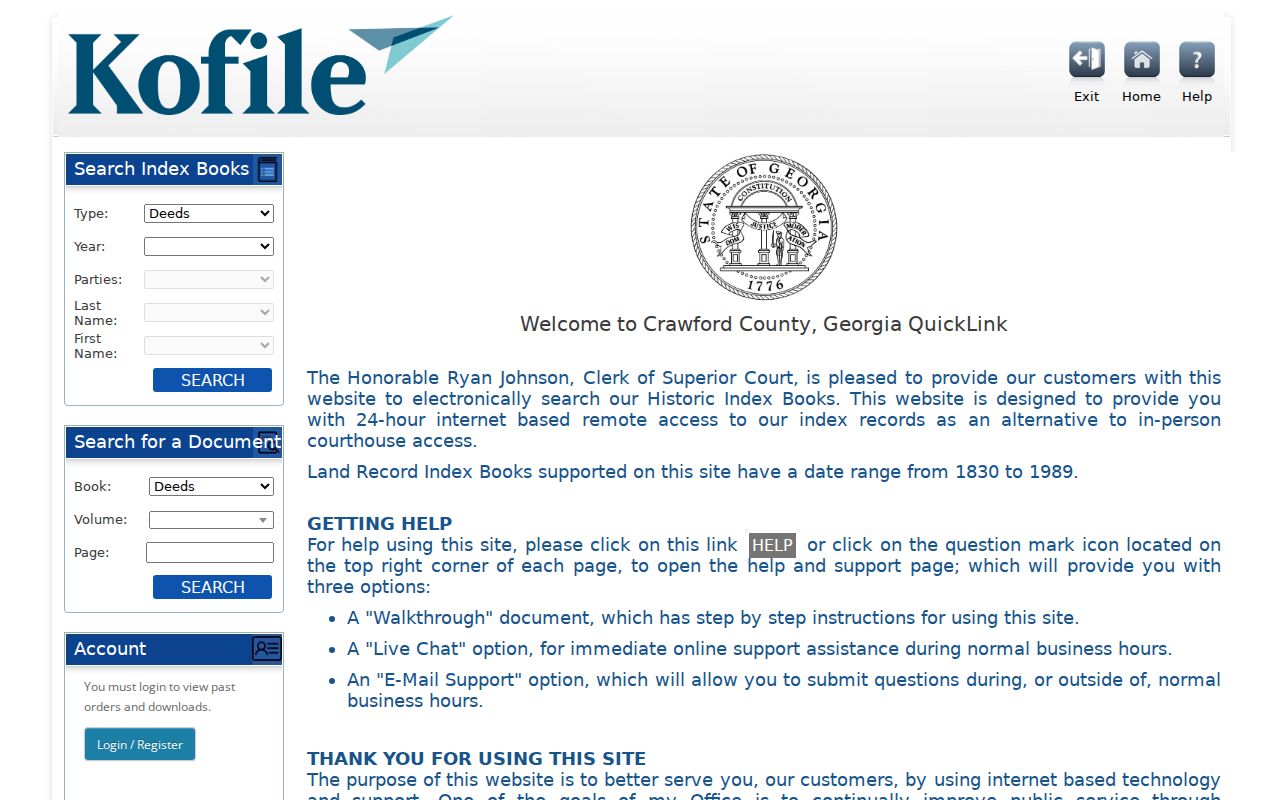
The Kofile landing page displays the historic index-book interface. Its stated era is 1830 through 1989, but that says nothing about the completeness of any individual deed image.
Crawford County Property Records in AssuranceGov
The Tax Commissioner's AssuranceGov search accepts several keys: parcel number, account number, bill number, or property address. Owner lookups add first and last name fields. Matching modes range from starts-with to contains to exact. Begin broadly with a name or address, then narrow by parcel key to separate similar rows.
| Known clue | Best Crawford source | Save from the result |
|---|---|---|
| Street address | qPublic or AssuranceGov | Parcel ID, situs, year |
| Owner name | AssuranceGov, qPublic, GSCCCA | Exact spelling and party role |
| Bill or account number | AssuranceGov | Tax year and print record |
| Book and page | GSCCCA or Clerk | Instrument image or certified-copy citation |
Compare the live tax-search form with the screen captured below.
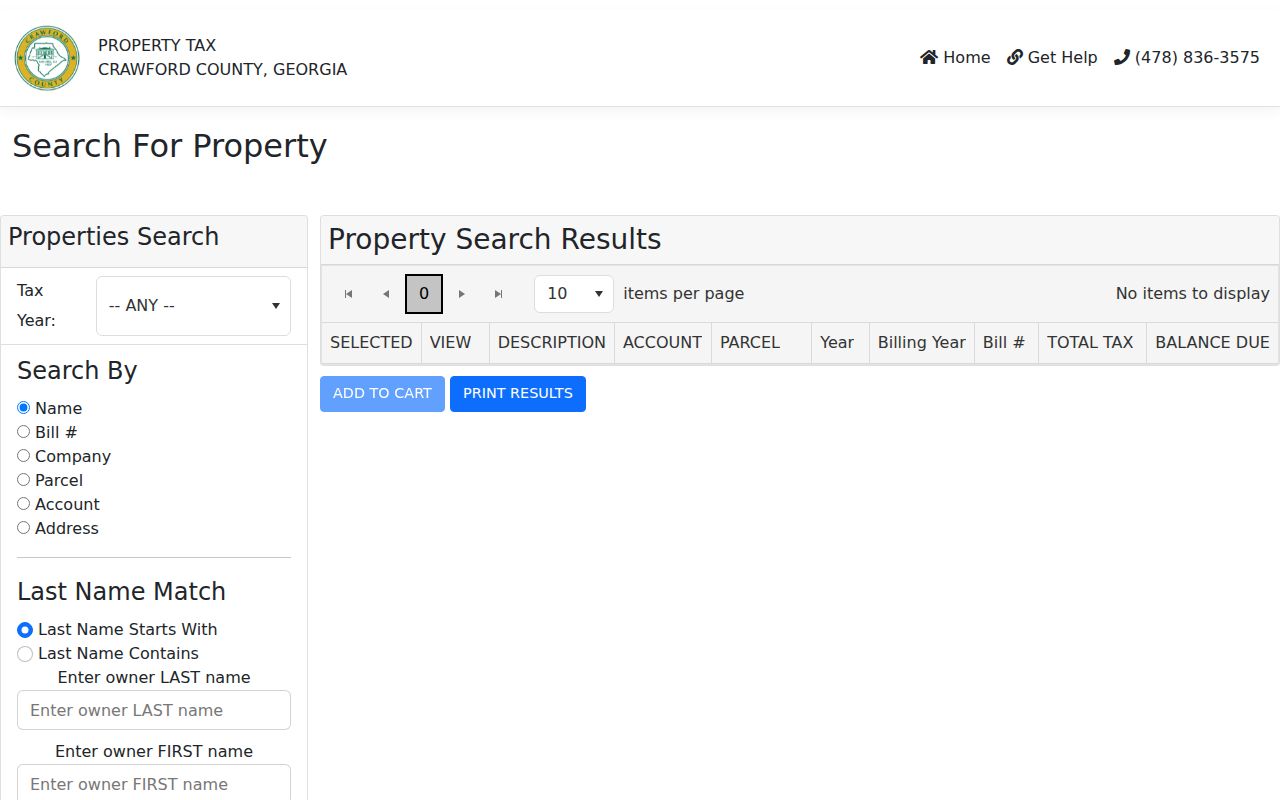
The search tools locate the account. The resulting bill still has to be reconciled against assessment and deed records before it settles anything.
Record Types in Crawford County Property Records
Crawford County property records span transactions, assessments, tax accounts, plats, court filings, and land-use material. Each record type serves one public function. Cite the source and date for every fact.
| Record Type | What It Documents | Kept By | Access |
|---|---|---|---|
| Deeds and conveyances | Named parties, instrument type, legal description, recording reference | Clerk of Superior Court | Kofile, GSCCCA, clerk request |
| Security deeds, liens, releases | Recorded claims and later cancellations or releases | Clerk and GSCCCA | Statewide index and clerk |
| Assessment and tax | Parcel identity, January 1 value, assessed value, billing and payment | Tax Assessor and Tax Commissioner | qPublic and AssuranceGov |
| Plats and zoning maps | Lot, block, land lot, district, zoning and map context | Clerk; Planning and Zoning | GSCCCA plat form and ArcGIS |
| Permits and land-use rules | Applications, compliance steps, and current regulations | County Planning and Zoning | GeoPermits, forms, office verification |
A deed conveys the ownership itself. An assessment name is just an administrative roll entry. A tax payment does not convey title, and a zoning classification fixes no boundary. The Crawford County deed records guide develops the recorded chain in detail.
Tax Values in Crawford County Property Records
Georgia applies a 40 percent assessment level to the fair-market value the Crawford County Tax Assessor sets for the digest. January 1 is the valuation date. Tax returns and many exemption applications carry an April 1 deadline. Appeals allow 45 days from the assessment notice. None of these figures proves a sale price.
Three numbers, three meanings
Fair-market value is the assessor's estimate for the stated year. Assessed value is the taxable figure. It comes from the statutory assessment level and any adjustments, while tax due emerges from billing with exemptions, millage, fees, and payment status all in play.
Property tax in Crawford County carries a normal December 20 due date, with a state-noted local-resolution caveat. Roberta city taxes are different. If due, City Hall in Roberta collects them, not the deed office.
City Names in Crawford County Property Records
Roberta stands alone as Crawford County's only incorporated city. Knoxville holds the courthouse and the county seat. It no longer has its own city government, though. County offices themselves often carry Roberta addresses. That is why a Crawford deed may name Knoxville as the recording place. Meanwhile the assessor and planning offices sit in Roberta.
Postal names and ZIPs are not municipal boundaries. The wider area draws on ZIPs 31050, 31052, 31066, and 31078. Check the parcel's tax district and city status through county sources first. Only then apply Roberta city-tax or incorporated-area land-use rules. The Roberta property records page keeps the city lens separate.
Current Permits Beside Crawford County Property Records
Crawford Planning and Zoning handles permitting for unincorporated county land and for Roberta. The office posts ordinances, permit forms, a Schneider GeoPermits system, and an ArcGIS zoning experience. The GeoPermits inspection pages are dynamic. So the county publishes no stable field schema for them. Crawford County also offers no open-data parcel download tied to its property records. When the dynamic pages leave a parcel question open, call 478-836-3199 or visit 640 GA Highway 128 in Roberta to confirm parcel-specific status. That call settles what the online tools cannot.
Recent postings include commercial process and manufactured-home documents dated April 8, 2026. Permit-fee documents carry a January 20, 2026 update. A Roberta incorporated-area land-development resolution was also updated in May 2026. Always check the live source date before applying an older requirement to a new project.
The 1830 Fire Behind Crawford County Property Records
The Crawford County Historical Society reports a courthouse fire around February 1830. Earlier records were later copied, as the Society puts it, only in substance. That gap shapes any early deed chain. Before relying on an entry, identify what you are viewing. It may be an original volume, a substitute copy, an index, or a microfilm image. A later copy can preserve the core transaction while losing features of the burned source.
Georgia Archives' Virtual Vault opens access to deed books, tax digests, and probate material. Scanned county microfilm collections offer the same. The Historical Society and Georgia Historic Newspapers add context such as estate notices and land advertisements. Their Crawford issues span 1888 through 2023. Treat them as supporting evidence, not substitutes for the recorded instrument.
Filing Alerts for Crawford County Property Records
GSCCCA's Filing Activity Notification System, known as FANS, is a free opt-in service. A registered user can receive an alert. This happens when a filing indexed under a chosen name enters the participating statewide system. Registration requires an account. The service itself warns that notices are not comprehensive. They are also not guaranteed to be accurate or current. Crawford County offers no separate alert system beyond this general state service.
An alert can prompt a fast review. It cannot block a filing, prove fraud, catch every name variant, or reconstruct old Crawford County property records. Keep the subscription names current, and check any notice against the recorded instrument itself. If a filing looks wrong, preserve the instrument number or book and page. Then contact the Crawford Clerk, and seek legal or law-enforcement guidance suited to the facts. Open the official FANS service to review the registration screen firsthand.
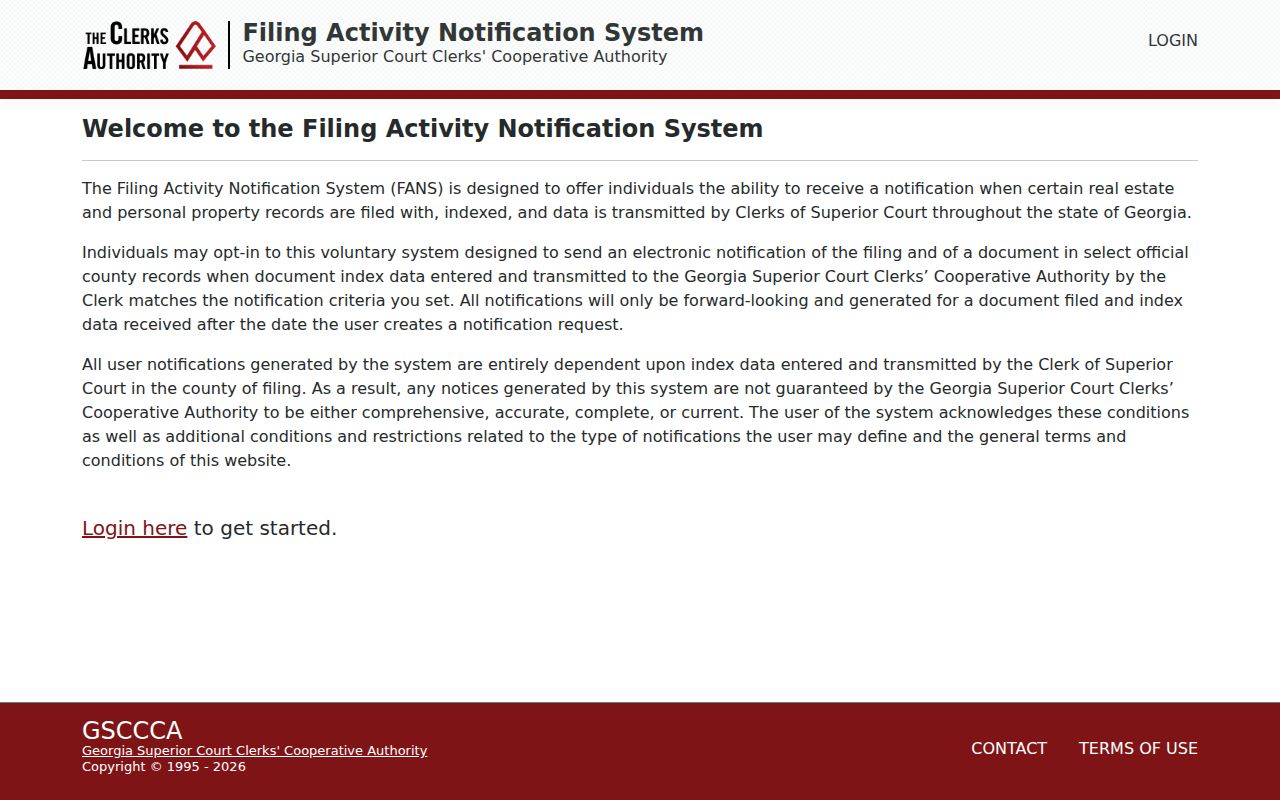
The registration screen shows the general state alert route. It is not a deed search or a Crawford-only fraud registry.
Court Records Add Context, Not Automatic Title Proof
Court filings can add useful context to a property records search. Crawford Superior Court dockets sometimes touch quiet-title actions, foreclosures, liens, probate disputes, and judgments against an owner of record. Georgia's eAccess page routes searchers to providers including PeachCourt. A provider account is required to search. The Magistrate Court at 100 GA Highway 42 South in Knoxville handles certain civil and personal-property matters within its jurisdiction.
Neither portal replaces the Clerk's real-estate index. A docket entry is only a lead. Confirm the filed order before drawing any conclusion. When a court order affects land, locate the order, identify the parcel or legal description, then search for the recording that carries the effect into the Crawford County deed records.
Request Crawford County Records Beyond the Portals
Online portals are not the only route to Crawford County property records. Some requests need a person. Ask the custodian for a certified deed, a parcel-card check, a tax-account clarification, or a permit-status answer. Older land and tax series live elsewhere. The Clerk, the Georgia Archives, and the Crawford County Historical Society hold them.
Log the office, date, terms, coverage, and response. That log lets others repeat the work. Georgia's Open Records Act, O.C.G.A. 50-18-70 et seq., opens a formal route to existing public records. Send the request to the likely custodian. Describe the item narrowly, supply a parcel number, party name, date range, or book/page, ask about format and cost; an agency need not create a custom title report or answer a legal question.
Annual Notices Are Not Parcel Proof
Countywide notices answer countywide questions. Crawford County posted an updated 2024 tax digest with a five-year levy history in October 2025, plus tax-increase hearing notices for August and September 2025, and an official 2025 millage-rate notice. They document the levy process and hearings. They prove nothing about one parcel. Value, exemptions, payment balance, ownership, and title come from the parcel's assessment card, the current tax bill, and the recorded deed.
Cite the notice year in any reference. A levy change can raise a tax bill even when the assessed value holds steady, and a changed value can move a bill without proving any sale. The two forces are separate. Blending them is how a countywide announcement gets misread as an individual Crawford County property record. Keep the digest, the hearing notices, and the millage notice in one file and the parcel documents in another.
Limits of Crawford County Property Records
Crawford County public records can carry real weight. An assessment roll names the owner of record, recorded instruments show parties, and the files hold assessed figures, tax-account status, zoning context, and plat references. They have limits, though. No property search on its own guarantees clear title, locates a surveyed boundary, establishes today's sale price, or proves who occupies a site. Restricted vital records keep their own access rules.
Lawful use. Use Crawford County property records for land research and civic transparency, never to stalk or harass; obtain legal, title, appraisal, or survey help when the decision requires it.