
Crawford County Tax Record Fields
Assessment and collection split the work in Crawford County. The Tax Assessor sets fair market value, applies the assessment level used for taxation, and maintains the digest record. The Tax Commissioner then creates the bill and collects it. That division matters when a figure looks off or a payment has not posted. Value and exemption questions belong with the assessor. Bill, payoff, and payment questions belong with the commissioner.
| Field | What It Shows | Where |
|---|---|---|
| Fair market value | The assessor's estimate of full value for the digest | Tax Assessor and qPublic |
| Assessed value | Forty percent of fair market value | Tax Assessor and assessment notice |
| Exemptions | Relief applied before the taxable amount is calculated | Tax Assessor |
| Tax bill and account | Tax year, amount billed, and collection record | Tax Commissioner and AssuranceGov |
| Millage and levy | The adopted rate used with assessed value | Annual county notices and the bill |
A tax bill is not a deed and proves no title. It also will not state what a buyer would pay on the open market. Crawford County applies Georgia's 40 percent assessment level. It then multiplies the relevant millage against the assessed value. An exemption can shrink the taxable figure. It does so without changing the assessor's estimate of fair market value. For a closer look at how those numbers are built, see the Crawford County property value record.
Search Crawford Tax Bills Online
The AssuranceGov Crawford Property Search is the collection-side lookup for tax bills. Its search form offers several routes to the same account. That helps when a street address is incomplete, the owner name is common, or the bill number is already in hand. The county portal page displays the search controls themselves. Confirm the tax year shown before relying on any total. The portal presents results by year.
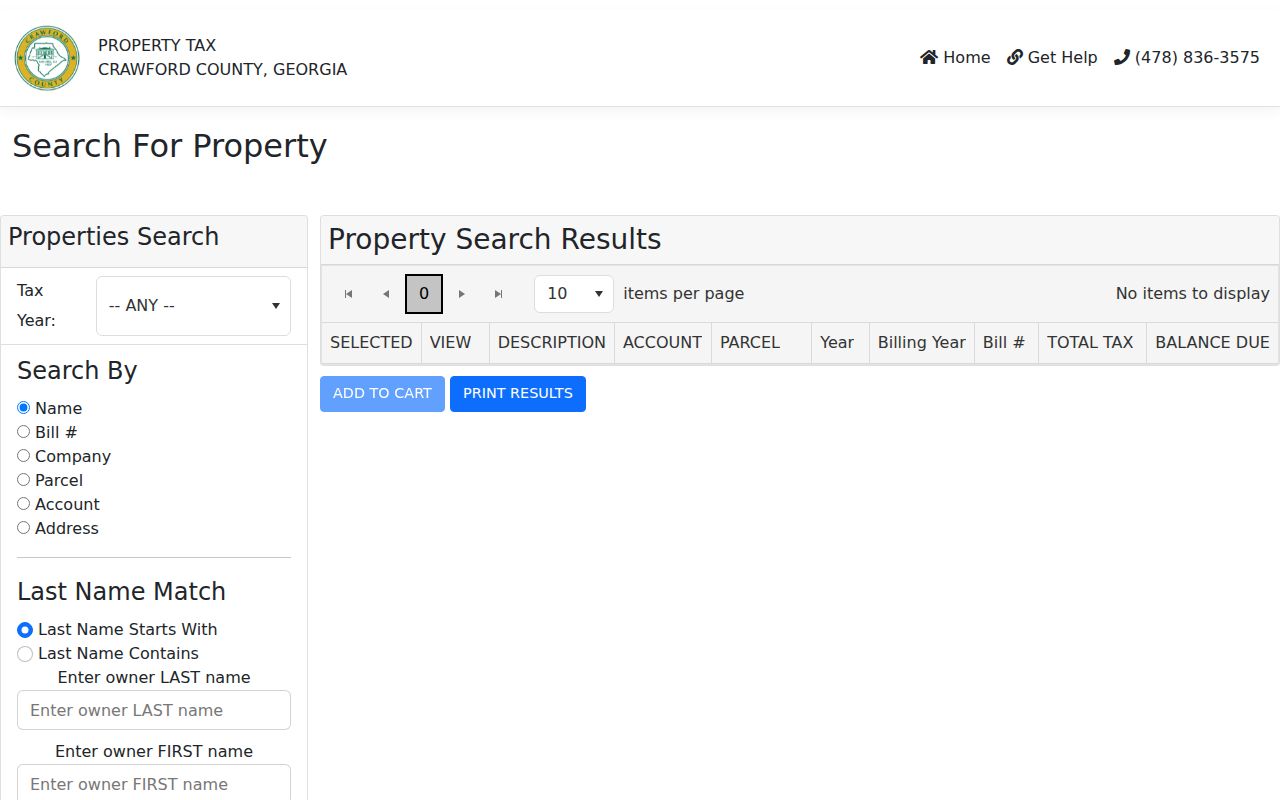
The county's search page shows where each control sits, but a result still must be tied to the right parcel and tax year before it means anything.
| Search control | Input | Use in Crawford County |
|---|---|---|
| Search By | Name, Bill #, Company, Parcel, Account, Address | Selects the lookup key |
| Last Name Match | Starts With or Contains | Broadens a spelling-sensitive owner query |
| Owner name | Last name and optional first name | Locates a person-linked account |
| Print Results | Page control | Preserves the returned account list |
A parcel, account, or bill number is usually the cleaner key, because owner names can appear with initials, entities, or spelling variants. Keep the tax year attached to every saved result. A printed row is an account lead, not proof that all later charges or payments are included.
Note: The portal does not publish its year range, result fields, export options, or any current card convenience fee.
Trace a Crawford County Tax Bill
A solid Crawford County property tax search starts with the physical address, then keeps the parcel or account number as the stable link. The assessor and collector systems answer different questions, so read both when the goal covers value, exemptions, and payment status. If the online page fails, the county office remains the official fallback.
- Search AssuranceGov by address. If the result is unclear, retry with the exact parcel, account, or bill number.
- Verify the tax year and account identity. Record the amount and status as displayed, then ask the Tax Commissioner for a current payoff when timing matters.
- Open the qPublic route or contact the Tax Assessor to compare value, tax district, and exemptions with the bill.
- If delinquency appears, check for later payment, FiFa, release, or recorded tax-sale deed. Delinquency by itself does not prove a sale.
- Assessed value
- The statutory share of fair market value used in the tax calculation.
- Millage or levy
- The adopted rate applied to assessed value, subject to the account's districts.
- Homestead exemption
- Tax relief that generally depends on ownership and legal residence on January 1.
- Tax lien
- A claim tied to unpaid tax. Its current status requires checking later releases and the custodian.
Online access is one channel of several. The Crawford County Tax Commissioner takes questions at 640 GA Hwy 128 in Roberta. Call 478-836-3575 or write to cctc@crawfordcountyga.org. Office hours run 8:15 a.m. to 4:45 p.m., Monday through Friday. The assessor sits at the same street address. The assessor can clarify digest and exemption fields by phone at 478-836-2800.
Crawford Tax Values Start January 1
Georgia property tax records use a January 1 valuation date. Crawford County assesses at 40 percent of fair market value. The tax itself follows that assessed figure and the adopted millage. A later sale, repair, or market shift may occur. That does not automatically rewrite the value date on the current digest.
Property returns may be filed from January 1 through April 1. A taxpayer who returned the property before and paid tax gets special treatment. That taxpayer may be treated as having returned it at the prior final value if no new return is filed. That rule explains why a current card may carry a figure from the prior digest. Check the official Georgia DOR Crawford tax facts. Compare it against the county notice for the year at issue.
Crawford County Property Tax Relief
Crawford County sources identify homestead, agricultural, preferential, conservation-use, historic-property, tax-exempt, senior, disabled-veteran, and Freeport-related relief. These are not one program. Each carries its own property-use, filing, and proof rules. An owner name on a parcel record establishes no eligibility.
Homestead generally requires the home to be owned and occupied as the applicant's legal residence on January 1. The first application is due by April 1. Missing that date can waive relief for the year. Freeport timing can extend through June 1 where the governing board has adopted it. Agricultural and conservation programs may also create longer-term obligations worth reviewing before a transfer.
Ask the Tax Assessor which application and evidence match the parcel. Keep a filed copy plus any approval or denial. The Tax Commissioner can show how an approved exemption reached the bill. But the assessor decides the exemption record.
Note: A mailing address outside Crawford County does not by itself prove a property's exemption outcome. It proves neither failure nor qualification.
Crawford Property Tax Calendar
Crawford County normally mails real-estate tax bills in mid-October, with payment due December 20. Georgia law allows some flexibility. A local resolution can move the due date to December 1 or November 15. It can also set installments instead. Treat the printed Crawford County property tax bill as the controlling document each year. A normal date is never a promise.
Falling behind gets expensive fast. Past-due accounts accrue interest. A 5 percent penalty applies every 120 days. FiFa charges follow once a general execution lands on the General Execution Docket. For a same-day payoff figure, call the Tax Commissioner. Online totals and annual notices can lag. The office accepts check, cash, money order, credit, and debit in person or by mail. It publishes no current online card fee.
Crawford Digest Notices Need Context
The county's updated digest and five-year levy notice and its official millage notice supply countywide context for the year. They walk through the levy process and rate changes. What they cannot do is settle one parcel's assessed value, exemptions, payment status, or title.
Mind the notice year. The county posted a 2024 digest history notice in 2025, alongside separate 2025 tax-increase hearing and millage materials. A public hearing date is never an individual assessment deadline. Set the annual notice beside the parcel's own assessment notice and bill before drawing conclusions.
Crawford Mobile Home Tax Records
A manufactured-home question can touch three county functions at once. Georgia DOR requires a placement permit within 30 days. It also requires an annual return filed between January 1 and April 1. Crawford County's tax material covers registration and relocation permits. It also covers digest status and off-digest tax after May 1. Planning and Zoning handles the separate placement and construction rules.
Start with the Tax Commissioner for the mobile-home tax and registration record. Then ask the assessor how the home and land appear on the digest. For permit status, use Crawford County Planning and Zoning. Write down the make, model, and serial details. Note the parcel and permit number exactly as the official file shows them. A home may be taxed with land, listed separately, or need a move permit. That is a record question. A map image cannot settle it.
Delinquent Crawford Tax Accounts
A past-due bill is one event in a longer record trail. Search the AssuranceGov account for the account history. Request a current payoff. Check the Clerk or GSCCCA indexes for a FiFa. Look there too for a tax sale deed, sheriff's deed, release, or later conveyance. Crawford County publishes no official tax-sale calendar, active parcel list, or redemption lookup. Direct confirmation matters.
The Georgia Department of Revenue lien page explains that a state tax-lien release goes to the clerk electronically after the liability is resolved. Keep county and state claims separate. An index entry stays in the history even after a release is recorded. Both the claim and its later status belong in the file.
Do not infer a sale. A delinquent account does not prove foreclosure, a tax sale, loss of ownership, or a current lien balance.
Appeal a Crawford County Assessment
An assessment appeal challenges the value or another item on the assessment notice. It is not a dispute over a bill payment. File the written appeal with the Crawford County Tax Assessor, not the Tax Commissioner. Georgia DOR sets the deadline. County sources agree. The appeal needs a postmark no later than 45 days from the notice mailing date.
The county's Tax Commissioner page displays the local tax calendar. It also lists payment details and office route for bill questions.

That office page handles bill questions. Written value appeals stay with the Tax Assessor.
Include the parcel number, the owner name as shown, the notice date, and the disputed value. Attach focused support where it helps: a recent arm's-length sale, a professional appraisal, photos of condition, or comparable parcel data. Keep proof of the mailing date. A payment credit or balance question goes to the commissioner instead.
Watch the notice date. Crawford County assessment appeals are due within 45 days of mailing and must go in writing to the Tax Assessor.
The assessor can often resolve the matter before the formal appeal path begins. Read the current notice for its election choices and instructions. Never substitute the April 1 return deadline or the December tax due date for the deadline printed on the assessment notice.