
Which Crawford County Deed Record Fits the Transfer
The Clerk of Superior Court's Real Estate Division records Crawford County land transactions. It also files deeds, plats, and related real-estate instruments. Deeds are not all alike. The label matters. A warranty deed promises more than a quitclaim. A foreclosure, sheriff, or tax-sale deed comes out of a court or statutory process instead of a private bargain. GSCCCA's instrument menu lists warranty, limited warranty, quitclaim, executor, and estate-related choices. Treat the label as a pointer only. It is a route to the document, not a legal interpretation of its effect.
| Deed Type | What It Does | Common Use |
|---|---|---|
| Warranty deed | Conveys the stated interest with broad title promises in the instrument | Conventional sale transfers |
| Limited warranty deed | Limits the grantor's promises to a defined period or claim | Sales using narrower warranties |
| Quitclaim deed | Conveys whatever interest the grantor has without promising that interest exists | Interest releases and title cleanup |
| Executor or estate deed | Reflects a conveyance made through estate authority | Probate-linked transfers |
| Foreclosure, sheriff, or tax deed | Records a transfer produced by the stated statutory process | Distressed-property events requiring added review |
A security deed or lien can burden title without conveying what a sale deed conveys. Releases can change that later. Neither event removes the earlier record. Read the full instrument sequence instead of treating the newest line containing "deed" as the whole Crawford County deed record.
Modern Crawford County Deed Records in GSCCCA
The GSCCCA real-estate name search pulls Crawford County deeds through the Authority Central Indexing System. Its coverage begins January 1, 1990. Pick Crawford County first. Then set a defensible date range and choose grantor, grantee, or both. A filter can hide a corrective deed or release.
| Index field | Deed-search use | Common check |
|---|---|---|
| Last or business name; first name | Find people, trusts, or entities | Try initials and spelling variants |
| Party type | Separate conveying and receiving roles | Search both roles across a chain |
| Instrument type | Narrow deeds, liens, releases, or plats | Repeat without the filter if results are thin |
| County and neighboring counties | Limit or expand the jurisdiction | Use adjacent counties only when facts justify it |
| Date range and display controls | Bound and document the query | Write down the exact window used |
Compare the live GSCCCA fields with the captured Crawford deed-search screen below.
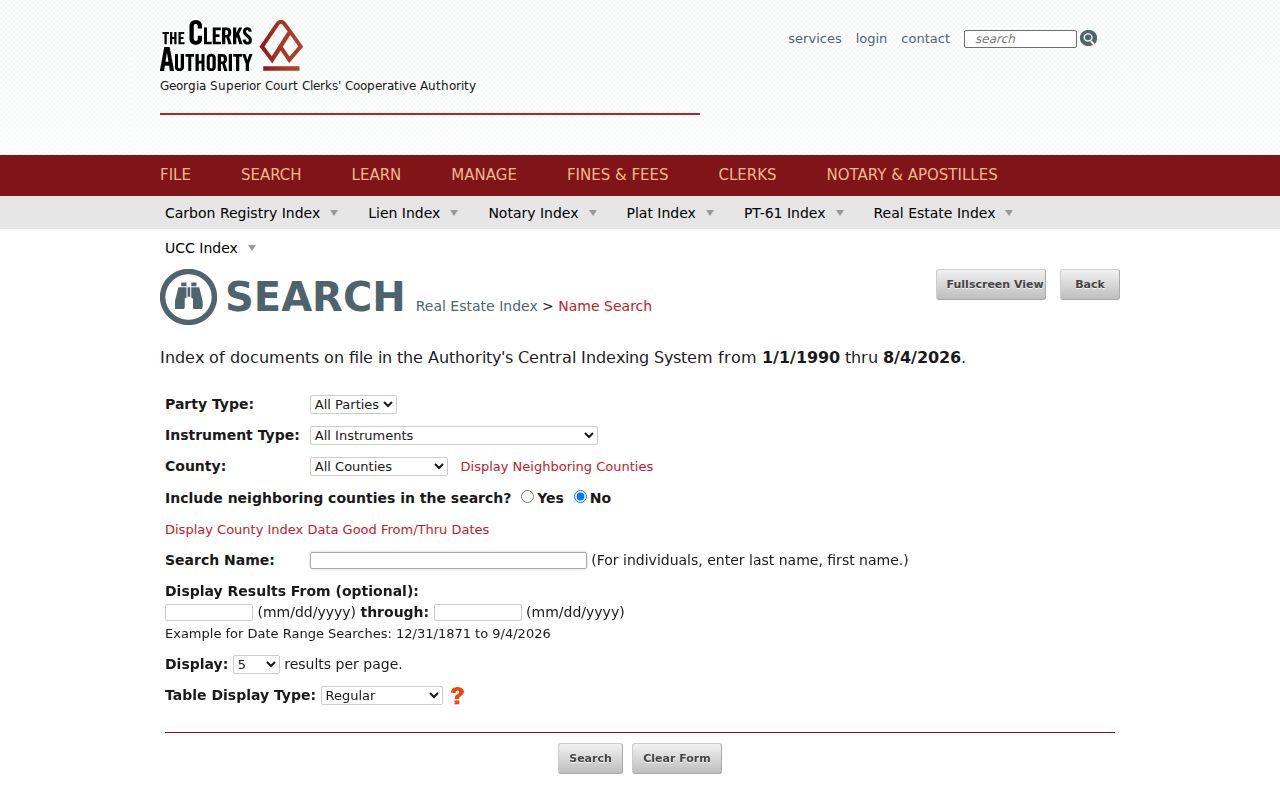
The public search screen shows open, free-standing search controls.
Kofile Carries Crawford Deed Records Back to 1830
The Crawford QuickLink historic index lists Land Record Index Books from 1830 through 1989. That window complements the modern GSCCCA system. The two eras barely overlap. Check names near the transition in both places, because recording and indexing dates rarely match the day a deed was signed. Kofile's landing view offers index-book browsing plus book, volume, and page controls. A login may block the image. Copy citations exactly. Include the book series and page. Give that reference to the Clerk if the image will not open, and for deed records predating the online index books, use clerk and archival channels rather than assuming no deed exists.
Build a Chain from Crawford County Deed Records
Start from the most recent credible owner clue. Work backward one recorded conveyance at a time. Names alone will not carry a chain. At each step, compare the legal description, land lot or district, acreage, deed type, execution and recording dates, and the book/page or instrument reference. A same-name match on different land is not part of the chain.
- Find the current party as grantee and open the purchase or transfer instrument.
- Read the grantor's indexed name and confirm that the land description matches.
- Search that grantor as an earlier grantee, widening spelling and date choices when needed.
- Track intervening quitclaims, corrective deeds, estate deeds, liens, releases, and plats.
- Move from GSCCCA to Kofile at the coverage boundary and to the Clerk or Archives for older material.
- Grantor
- The party conveying the interest identified in the instrument.
- Grantee
- The party receiving that stated interest.
- Chain of title
- The linked sequence of recorded transfers affecting the same land.
- Book/page and instrument number
- References used to retrieve a recorded document; copy the identifier exactly as indexed.
Find Crawford County Deed Records by Book and Page
GSCCCA also offers a separate real-estate book/page search. It covers the same modern window. When a deed, plat, tax record, or later instrument cites a book and page, the direct route avoids ambiguity from initials, changed surnames, entity punctuation, or an index misspelling. Use it with a citation in hand.
The route still requires a county selection. Confirm the retrieved image names Crawford County and contains the expected parties and land. The PT-61 transfer form and recorded consideration can add sale-price context, but neither stands alone as an ownership record. The deed itself controls. Open the official GSCCCA book/page form to reach the search directly.
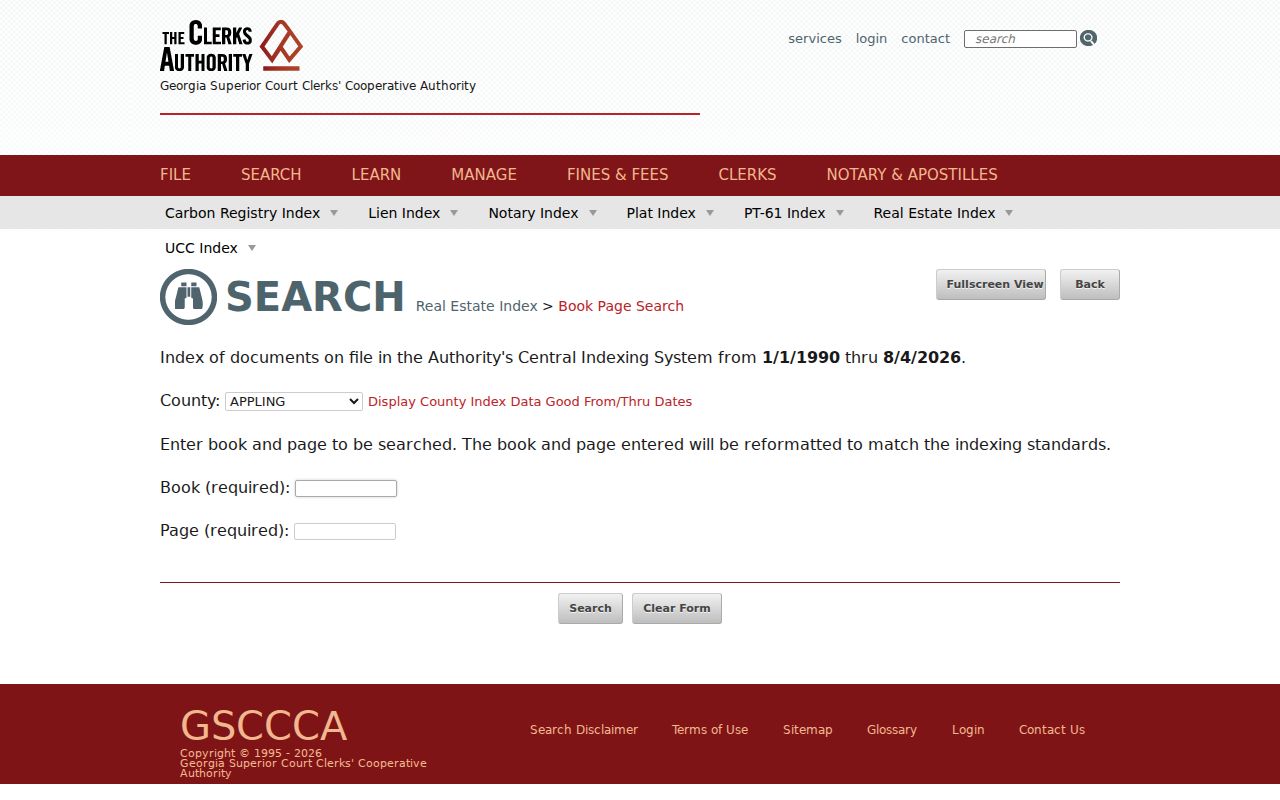
It helps most with a precise citation in hand.
Plats Linked to Crawford County Deed Records
The Clerk records plats, not just deeds. A deed may cite a subdivision, lot, block, land lot, district, or plat book instead of spelling out every boundary call. GSCCCA's plat form filters by name, GMD, district, land lot, county, date, and instrument. Find the referenced map. Then compare the deed's citation to the plat title and recording details.
Easements and restrictions can bind the land. So can later re-plats. Neither one changes the owner name. A GIS outline helps with orientation but cannot replace the recorded plat or a survey; for boundary-specific work, the county's parcel and plat guide explains how map clues fit beside recorded evidence.
The 1830 Fire in Crawford County Deed Records Research
The courthouse burned around February 1830. The Crawford County Historical Society says earlier surviving records were then ordered copied "in substance." That fire shaped the deed record. Provenance becomes part of any early chain. A later copy can preserve the core transaction while skipping original marks, terms, or page arrangement. Note the format. An image may be an original volume, a reconstructed copy, an index entry, or later microfilm.
Georgia Archives' Virtual Vault and scanned county microfilm offer another route to early deed books, tax digests, and probate materials. The Historical Society and historic newspapers add names and event context. Neither replaces a recorded deed. When sources disagree, report it. Ask the Clerk or Archives about the record series rather than smoothing the difference away.
FANS Watches New Filings, Not Old Crawford Deeds
GSCCAA's FANS, the Filing Activity Notification System, is a free opt-in service. A registered user can enroll criteria and get an alert when a future filing matches. Crawford County offers no separate fraud-alert signup of its own beyond this statewide system. FANS looks forward only. It requires an account. The service itself cautions that notifications are not comprehensive and are not guaranteed accurate or current.
Treat any alert as a prompt, not proof. Pull the actual indexed instrument and contact the Clerk if a filing looks unfamiliar. An alert does not monitor a whole historic chain. It does not remove a document. It does not decide whether a filing is valid. Keep the instrument or book/page number handy when reporting a suspected fraudulent recording.
Order a Crawford County Recorded Deed Copy
Begin with an online index or book/page search and save the full citation before requesting anything. For an authoritative copy, contact the Crawford County Clerk of Superior Court, Real Estate Division, at 100 GA Highway 42 South, Knoxville, Georgia 31050, or call 478-836-3328. Ask whether the deed copy can be delivered electronically, by mail, or at the counter, whether it needs certification, and what the current copy and certification charges are. No single universal remote-copy price applies, so confirm the cost before sending payment.
Without a precise citation, give the office the party names, approximate recording dates, deed type, and land description. Georgia's Open Records Act, O.C.G.A. 50-18-70 et seq., supports a focused request for an existing public record, though the office need not build a chain-of-title report. For legal assurance, take the assembled Crawford County deed records to a Georgia lawyer or title professional.
Recorded, not guaranteed. Crawford deed records show accepted filings, but an index is not a title opinion and cannot rule out unrecorded interests.