
Tracing Former Crawford County Property Owners by Era
Crawford County previous owners trace across a practical handoff between the Clerk, two online indexes, and archival holdings. The date sets the starting point. Every name hit still needs its recorded image, instrument type, and land description.
| Source | Years It Covers | Where Held | What It Shows |
|---|---|---|---|
| GSCCCA real-estate index | 1990 through the displayed 2026 endpoint | Statewide authority and Clerk | Grantor, grantee, instrument, dates, and book/page leads |
| Kofile Land Record Index Books | 1830-1989 | Crawford QuickLink and Clerk | Earlier party and book/volume/page references |
| Recorded plats | As indexed and available | Clerk and GSCCCA plat search | Subdivision, lot/block, district, land lot, and survey context |
| Tax digests and microfilm | Historic holdings vary | Georgia Archives and local custody | Assessment leads and images of older record books |
Start with the newest deed. Even when the question reaches back much further, that deed supplies the parcel description plus a prior owner's name. Once the chain crosses the 1990 handoff, move from GSCCCA into Kofile. Then the Clerk or Archives fills any image gap.
Finding Crawford County Previous Owners After 1990
GSCCCA's Authority Central Indexing System covers Crawford County deeds from January 1, 1990 forward. The name search form is detailed. It accepts county, party type, instrument type, name, date limits, and display options. Pick grantee to see how someone acquired the land. Pick grantor to see how that person later conveyed it. Some results and images require an account. A blank unauthenticated screen reflects an access condition rather than proof that no deed exists. Record spelling variants, initials, entity suffixes, recording dates, and the county on every hit. A neighboring-county option helps when a chain references a nearby county, but search Crawford first.
Following Crawford County Prior Owners Through Kofile
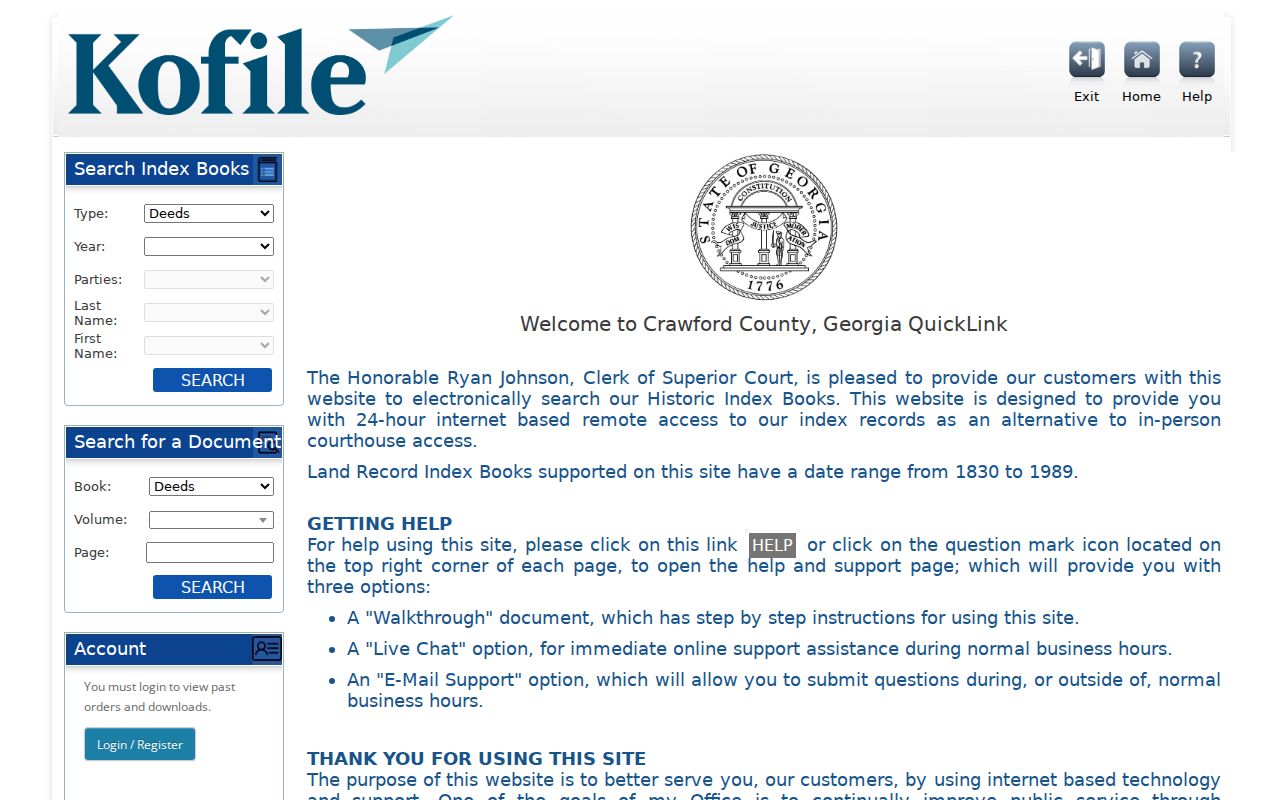
Kofile's Crawford QuickLink indexes Land Record Index Books from 1830 through 1989. It bridges the statewide index and the older books. Search controls include type, year, party name, book, volume, and page. The index never replaces the deed image itself. A historic entry may abbreviate a name or point to several conveyances, so record the full citation and inspect each one against the land description. Compare roads, streams, and adjoining owners. Keep the plat citation for lot and block land.
Walking the Crawford County Deed Chain Backward
Walking the chain backward runs on one identity test. The grantor on one deed should appear as the grantee on an earlier deed for the same land. One Crawford County name can attach to several tracts.
- Find the present ownership deed and record its grantee, grantor, deed type, recording date, and book/page.
- Read the legal description and any earlier deed or plat citation written into the instrument.
- Search the grantor as an earlier grantee, then confirm that the earlier deed describes the same tract.
- Repeat across GSCCCA and Kofile, moving to books or Archives microfilm when the online trail ends.
- Grantor
- The party conveying the interest described by the instrument.
- Grantee
- The party receiving that interest.
- Chain of title
- The linked sequence of instruments affecting ownership of the same land.
- Reverse index
- An index used to trace a party through the opposite role or back in time.
- Quitclaim and warranty deed
- Conveyances with different promises; either must be read rather than judged by label alone.
Reading Deed Types Across Crawford County Past Owners
A Crawford County chain can hold warranty deeds, quitclaims, estate deeds, foreclosure deeds, sheriff's deeds, tax-sale deeds, and corrective instruments. Security deeds, liens, releases, easements, and rights of way sit between transfers too. None of those is a standard sale. Follow parties and land, not dates. A corrective deed repairs a name or description. An estate deed may need probate authority, and the Crawford County deed guide covers single-instrument mechanics that this chain work simply repeats.
Using Crawford County Plats to Keep Former Owners on One Tract
Street names, postal labels, and parcel numbers all change over time. A recorded plat is the stable bridge. GSCCCA's plat form filters by name, GMD, district, land lot, county, date, and instrument. Capture the subdivision name, lot and block, district or land lot, plat book and page, surveyor, easements, dedications, revisions, and vacations. A current GIS map can locate the tract. It cannot repair a missing deed or decide which legal description controls.
The 1830 Crawford County Record-Fire Problem
The Crawford County Historical Society reports the courthouse burned around February 1830. Surviving officials ordered earlier records copied, in substance only. That creates a provenance problem for former owners near or before the fire. A later copy may keep the main transaction. It may drop fine terms anyway. Label each source by type. Compare Clerk holdings with Georgia Archives deed-book, tax-digest, and probate microfilm. When a chain turns on a pre-1830 event, state the evidence limit instead of claiming an unbroken original set.
Newspaper Leads for Crawford County Former Owners
Georgia Historic Newspapers offers searchable Crawford County issues through 2023. Legal notices can surface estate administrations and sheriff sales. They can also surface tax sales, lost deeds, rights of way, and courthouse actions. That helps when the instrument type is unknown. Treat every notice as a lead, not a record. Carry the name, date, land clue, and book or page reference into the Clerk's index. OCR distorts names. Roberta's railroad history points to 1888-1892 issues for depot, station, lot, and right-of-way clues. Publication never replaces a recorded conveyance.
How Far Back Crawford County Ownership Records Go
Remote indexing reaches back to 1830 through Kofile. Older or missing links may require local books, Georgia Archives collections, land-grant context, probate material, or tax digests. A collection page is not full digitization.
Time-depth limit. The online chain changes systems at 1990 and confronts an early fire. Older owners require book images, provenance notes, and Clerk or Archives checks.
Prior-owner research earns its keep for house history. It also serves title questions, boundary disputes, and lawful archival study. Handle it responsibly. Never expose sensitive estate details. Never turn an old address into a way to bother a living person. For the present assessment name, the current-owner guide covers that lookup step by step.
The Crawford Kofile index is the public historic entry point. Its landing screen shows the stated book range and the search controls you will use.
An index route is only the first step. It is not a complete chain of ownership. Every former owner still must be confirmed against the cited deed image and a same-tract comparison before it counts.
A final chain ledger should give each transfer its own row: recording date, grantor, grantee, deed type, book and page, legal-description match, and the source image consulted. Keep execution dates and recording dates separate. Add a note whenever an instrument conveys only part of a tract, reserves an easement, corrects an earlier deed, or rests on an estate or court authority. These details matter. They explain why a surname sequence may not form a tidy series of sales.
Tax digests can test whether a name appears near the expected year. Still, assessment continuity cannot fill a missing deed. A cemetery list, obituary, city history, or newspaper notice may explain an estate lead without conveying any land. Return every clue to the Clerk's recorded chain of title. And if the land description shifts from acreage calls to a subdivision lot, identify the plat or division instrument that created the new description before reaching farther back.
For a certified or litigation-grade conclusion, a professional title examination may be needed. A public-record workflow organizes likely sources and exposes gaps. It does not insure title or decide competing claims.